Protocol Mechanics
The essence of Gluon is that, analogously to how an atom's nucleus is composed of protons and neutrons (known collectively as nucleons), a base token is composed of two sub-assets: neutrons (or stable tokens), whose price is kept stable relative to a target price; and protons (or volatile tokens), whose price is more volatile than the base token.
The protocol defines the rules of an autonomous reactor capable of four reactions:
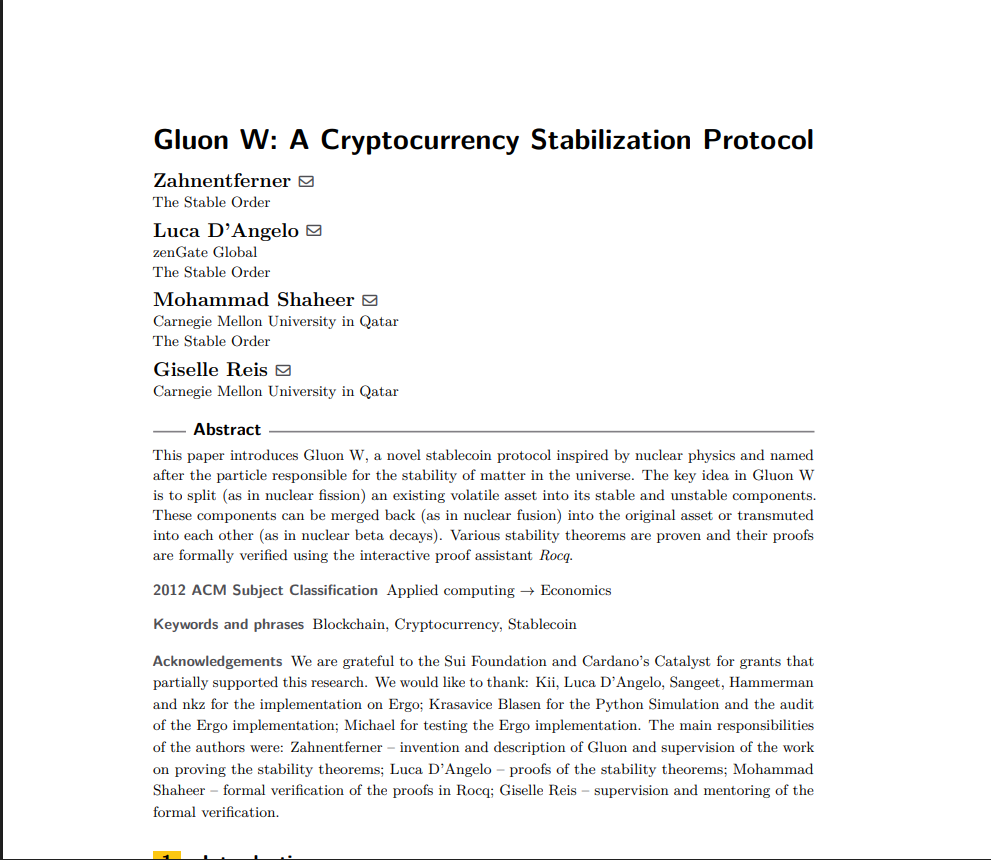
Research Whitepaper
A peer-reviewed cryptocurrency stabilization protocol leveraging dual-token mechanics and state-dependent settlement rules.
Why Gluon
Neutrons (Stable Tokens)
Maintain predictable price stability tied to a target peg while benefiting from reserve-strengthening protocol fees.
Protons (Volatile Tokens)
Gain leveraged exposure to the underlying reserve asset while capturing protocol growth and transaction fees.
Zero-Governance & Autonomy
Gluon reactor smart contracts operate completely autonomously on-chain without central administration, admin keys, multi-sigs, or DAO parameter voting.
Resilience to Oracle Delays and Manipulations
Dynamic conversion fees based on transaction volume protect the reserve against potential oracle issues.
No Liquidations or CDP Debt
Mint and hold stable coins without liquidation risks, forced debt closures, or paying borrowing interest rates.
Freedom from Hard Reserve Cutoffs
Execute all core operations continuously without rigid minimum or maximum reserve ratio thresholds.